Manejo da anafilaxia perioperatória sob a visão dos anestesiologistas
Management of perioperative anaphylaxis from the anesthesiologist perspective
Iara Victória dos Santos Moura; Maria Eduarda Pontes Cunha-de Castro; Aynoa Cristianne Lima Macedo; Bianca Barbosa Oliveira Falheiros


Resumo
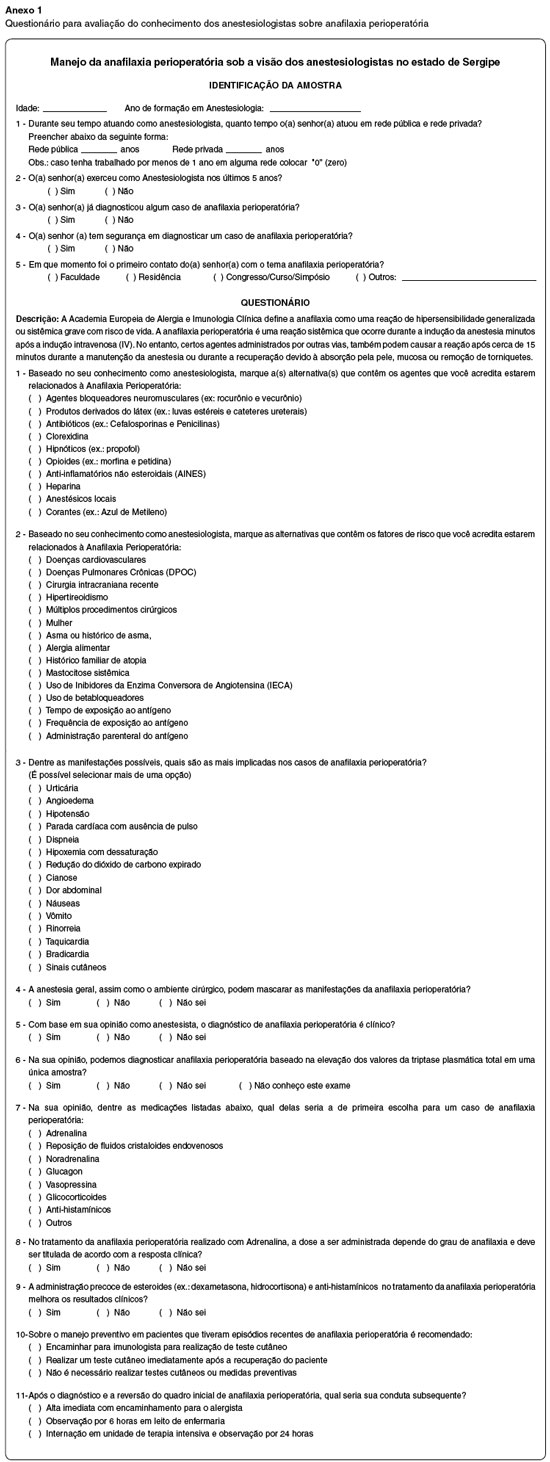
A anafilaxia perioperatória é uma reação sistêmica grave que pode ocorrer em qualquer período durante as etapas cirúrgicas, geralmente minutos após a indução anestésica, podendo ocorrer também com agentes administrados por outras vias (como clorexidina, látex e azul de metileno). A epidemiologia global sugere um aumento na incidência da anafilaxia induzida por drogas, destacando a necessidade de melhoria no diagnóstico e manejo de tal condição. O objetivo deste artigo é descrever o conhecimento sobre o manejo da anafilaxia perioperatória pelos anestesiologistas. Trata-se de um estudo descritivo, exploratório, quantitativo, realizado de maio a outubro de 2023. Os dados foram coletados via questionário online e visou avaliar o conhecimento dos anestesiologistas sobre agentes desencadeantes, fatores de risco, manifestações clínicas, diagnóstico, tratamento e prevenção da anafilaxia perioperatória. O questionário foi construído após revisão da literatura sobre as principais informações acerca do tema. Participaram da pesquisa 29 anestesiologistas. Apesar de haver conhecimento acerca de determinados agentes etiológicos envolvidos na anafilaxia, 10,3% dos anestesiologistas não assinalou os bloqueadores neuromusculares e apenas 48,3% considerou a clorexidina como opção. Apenas 27,6% e 6,9% indicou o sexo feminino e o uso de medicamentos betabloqueadores como fatores de risco relevantes. A hipotensão foi descrita como principal manifestação clínica por 93,7% dos participantes. O uso de adrenalina no tratamento foi afirmado por 89,7% e, apesar de não haver evidências convincentes, 48,3% dos médicos indicou o uso de corticoide. Não houve diferença significativa de pontuação entre formados em anestesiologia há mais de 5 anos e formados há menos de 5 anos, nem em relação à idade, primeiro contato com o tema ou tempo de atuação como especialista. Não foram encontradas diferenças significativas nas pontuações relativas às variáveis avaliadas. Muitos participantes apresentaram déficits no conhecimento sobre anafilaxia perioperatória, representando um risco potencial para os pacientes.
Palavras-chave
Abstract
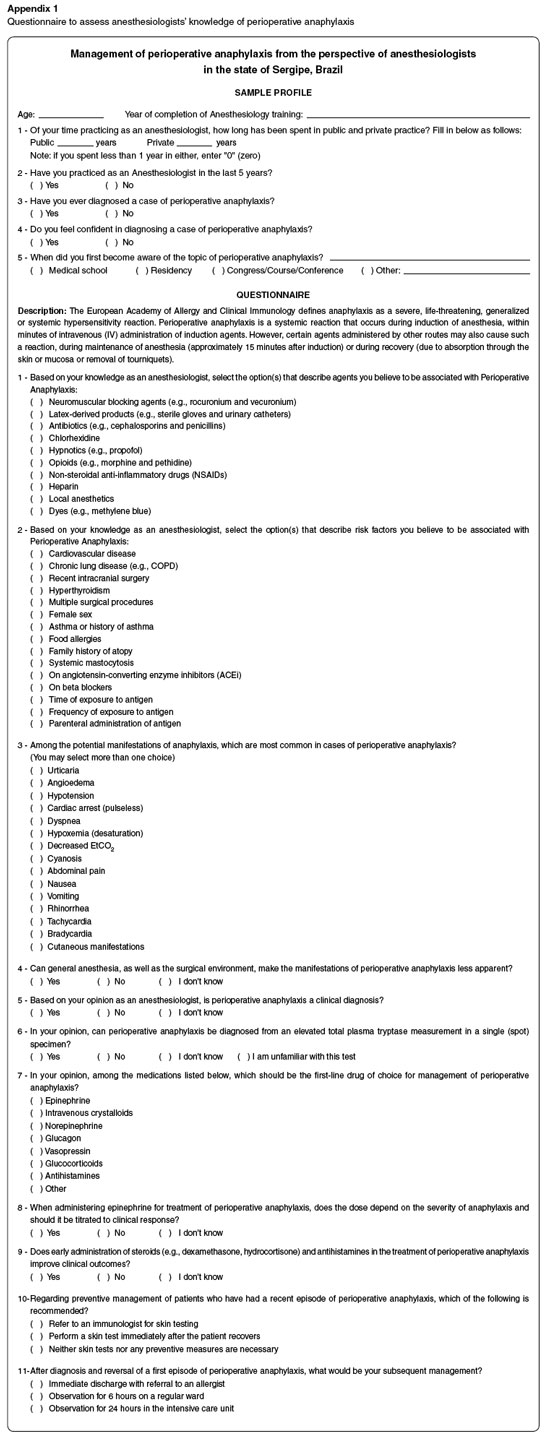
Perioperative anaphylaxis is a severe systemic reaction that can occur at any point during the surgical procedure, typically minutes after induction of anesthesia, and can also be caused by agents administered via other routes (such as chlorhexidine, latex, and methylene blue). Global epidemiology suggests an increase in the incidence of drug-induced anaphylaxis, highlighting the need for improved diagnosis and management of this condition. This study aims to describe anesthesiologists’ knowledge of perioperative anaphylaxis management. This is a descriptive, exploratory, quantitative study conducted from May to October 2023. Data were collected through an online questionnaire aimed at assessing anesthesiologists’ knowledge of triggering agents, risk factors, clinical manifestations, diagnosis, treatment, and prevention of perioperative anaphylaxis. The questionnaire was developed based on a review of the literature on the topic. The study included 29 anesthesiologists. Although anesthesiologists were aware of certain etiologic agents involved in anaphylaxis, 10.3% of them did not mention neuromuscular blockers, and only 48.3% considered chlorhexidine an option. Only 27.6% and 6.9% identified female sex and beta-blocker use as significant risk factors. Hypotension was reported as the main clinical manifestation by 93.7% of participants. The use of epinephrine for treatment was reported by 89.7%, and despite the lack of convincing evidence, 48.3% of anesthesiologists recommended the use of corticosteroids. No significant difference in scores was found between those who graduated in anesthesiology more than 5 years ago and those who graduated less than 5 years ago, nor in relation to age, first contact with the topic, or years of experience as a specialist. No significant differences were found in scores related to the variables of interest. Many participants had deficient knowledge of perioperative anaphylaxis, posing a potential risk to patients.
Keywords
References
1. Aun MV, Garro LS, Ribeiro MR, Motta AA, J Kalil, Giavina-Bianchi P. Anafilaxia perioperatória: A experiência brasileira. Rev Port Imunoalergol. 2016 Jun;24(2):99-106.
2. Valencia MIB. Anafilaxia perioperatoria. Rev Bras Anestesiol. 2015;65(4):292-7. doi: https://doi.org/10.1016/j.bjan.2014.09.002.
3. Kosciuczuk U, Knapp P. What do we know about perioperative hypersensitivity reactions and what can we do to improve perioperative safety? Ann Med. 2021 Jan;53(1):1772-8.
4. Garvey LH, Ebo DG, Mertes PM, Dewachter P, Garcez T, Kopac P, et al. An EAACI position paper on the investigation of perioperative immediate hypersensitivity reactions. Allergy. 2019 Oct;74(10):1872- 84. doi: https://doi.org/10.1111/all.13820.
5. Ebo DG, Mertes PM, Garvey LH, Dewachter P, Scherer K, Luyckx J, et al. Molecular mechanisms and pathophysiology of perioperative hypersensitivity and anaphylaxis: a narrative review. Br J Anaesth. 2019 Jul;123(1):49.
6. Di Leo E, De Gregorio C, Cavaliere G, De Re V. Focus on the agents most frequently responsible for perioperative anaphylaxis. Clin Mol Allergy. 2018;16(1):19.
7. Vorobeichik L, Weber EA, Tarshis J. Misconceptions Surrounding Penicillin Allergy. Anesth Analg. 2018 Sep;127(3):642-9.
8. Villén FE, Navas SS. Anafilaxia en anestesia. Rev Esp Anestesiol Reanim. 2013;60:55-64.
9. Laguna J, Archilla J, Doña I, Corominas M, Gastaminza G, Mayorga C, et al. Practical guidelines for perioperative hypersensitivity reactions. J Investig Allergol Clin Immunol. 2018 Aug;28(4):216-32.
10. Fonseca CSBM, Moraes IC, Contin IN, Maeda LH, Uehara MK, Almeida MEC, et al. Anafilaxia: conhecimento médico sobre o manejo em anafilaxia. Estudo em urgentistas na cidade de Petrópolis - RJ. Rev Bras Alerg Imunopatol. 2009;32(1):9-12.
11. Santos TP, Almeida GRF, Lins LC, Moreira IFM. Atendimento a pacientes com anafilaxia: conhecendo as principais condutas médicas nos setores de urgência e emergência dos hospitais da cidade de Maceió, Alagoas. Braz J Allergy Immunol. 2014;2:231-4.
12. Silva WA, Macêdo Pinheiro A. Reações anafiláticas em anestesia. J Surg Clin Res. 2020 May 22;11(1):66-72.
13. Tacquard C, Iba T, Levy JH. Perioperative anaphylaxis: reply. Anesthesiology. 2023 May 29;139(3):362-4.
14. Filho AAMT, Castro MEPC de. Perfil epidemiológico das principais drogas e substâncias relacionadas à etiologia da anafilaxia perioperatória no Brasil e no mundo: uma revisão literária. Braz J Health Rev. 2021 May 17;4(3):10695-716.
15. Solé D, Ivancevich JC, Borges MS, Coelho MA, Rosário NA, Ardusso LRF, et al. Anaphylaxis in Latin America: a report of the online Latin American survey on anaphylaxis (OLASA). Clinics. 2011 Jun;66(6):943-7.
16. Aun MV, Blanca M, Garro LS, Ribeiro MR, Kalil J, Motta AA, et al. Nonsteroidal anti-inflammatory drugs are major causes of drug-induced anaphylaxis. J Allergy Clin Immunol Pract. 2014 Jul- Aug;2(4):414-20. doi: 10.1016/j.jaip.2014.03.014.
17. Cook TM, Harper NJN, Farmer L, Garcez T, Floss K, Marinho S, et al. Anaesthesia, surgery, and life-threatening allergic reactions: protocol and methods of the 6th National Audit Project (NAP6) of the Royal College of Anaesthetists. Br J Anaesth. 2018 Jul;121(1):124-33.
18. Yim R. World Federations Societier of Anesthesiologists. ATOTW tutorial. 2016;324:1-6.
19. Caffarelli C, Stringari G, Pajno GB, Peroni DG, Franceschini F, Iacono ID, et al. Perioperative allergy: risk factors. Int J Immunopathol Pharmacol. 2011 Jul;24(3 Suppl):27-34.
20. Mirone C, Preziosi D, Mascheri A, Micarelli GL, Farioli L, Balossi LG, et al. Identification of risk factors of severe hypersensitivity reactions in general anaesthesia. Clin Mol Allergy. 2015 Jun 22;13(1):16.
21. Solé D, Spindola MAC, Aun MV, Azi LA, Bernd LAG, Bianchi D, et al. Abordagem das reações de hipersensibilidade perioperatória: orientações da Sociedade Brasileira de Anestesiologia e da Associação Brasileira de Alergia e Imunologia - Parte II: etiologia e diagnóstico. Arq Asma Alerg Imunol. 2020;4(3):112-29.
22. Oldfield EH, Merrill MJ. Blood-brain barrier disruption in the treatment of brain tumors: clinical implications. J Neurosurg. 1996 Dec;85(6):1056-64. doi: 10.3171/jns.1996.85.6.1056.
23. Kadry H, Noorani B, Cucullo L. A blood-brain barrier overview on structure, function, impairment, and biomarkers of integrity. Fluids Barriers CNS. 2019 Dec 18;16(1):6. DOI: https://doi.org/10.1186/s12987-019-0134-6.
24. Lee J, Rabai F. Blood-Brain Barrier. OpenAnesthesia [Internet]. 2023 Mar 4. Disponível em: https://www.openanesthesia.org/keywords/ blood-brain-barrier/. Accessado em: 09/09/2024.
25. Long E, Kaufman D, Clark P, McLeod M. Recognition, treatment, and prevention of perioperative anaphylaxis: a narrative review. AIMS Med Sci. 2022;9(1):32-50.
26. Smith MA, Newton LP, Blanch MAB, Cuervo-Pardo L, Cho L, Newton D, et al. Risk for anaphylactic reaction from cardiac catheterization in patients receiving beta-adrenergic blockers or angiotensin-converting enzyme-inhibitors. J Allergy Clin Immunol Pract. 2020;8(6):1900-5. doi: 10.1016/j.jaip.2019.10.020.
27. Huang W, Li X, Xiang Y, Li J, Zhou X, Zheng X, et al. Risk factors and prevention for perioperative anaphylaxis: a nested case-control study. Int J Clin Pharm. 2019 Dec;41(6):1442-50. doi: 10.1007/ s11096-019-00902-7.
28. Mertes PM, Alla F, Tréchot P, Auroy Y, Jougla E. Anaphylaxis during anesthesia in France: an 8-year national survey. J Allergy Clin Immunol. 2011 Aug;128(2):366-73.
29. LoVerde D, Iweala OI, Eginli A, Krishnaswamy G. Anaphylaxis. Chest. 2018 Feb;153(2):528-43.
30. Kalangara J, Vanijcharoenkarn K, Lynde GC, McIntosh N, Kuruvilla M. Approach to perioperative anaphylaxis in 2020: updates in diagnosis and management. Curr Allergy Asthma Rep. 2021 Jan;21(1):4.
31. Simons FER, Ardusso LRF, Bilo MB, Cardona V, Ebisawa M, El- Gamal YM. International consensus on anaphylaxis. World Allergy Organ J. 2014;7:9.
32. Sociedade Brasileira de Pediatria, Departamento Científico de Alergia. Guia Prático de Atualização - Anafilaxia: atualização 2021 [Internet]. 2021. Disponível em: https://www.sbp.com.br/fileadmin/user_upload/22970c-GPA-Anafilaxia_-_Atualizacao_2021.pdf
33. Figueira MCBS, Sarinho ESC. Uso de corticoides e anti-histamínicos na prevenção da anafilaxia: uma revisão bibliométrica. Arq Asma Alerg Imunol. 2017;1(4):335-41.
Submitted date:
04/21/2024
Accepted date:
10/24/2024
 Facebook
 LinkedIn
 Mendeley
 StumbleUpon
 Reddit
 Email
Email